TCS Sydney Marathon ·
Sydney Marathon start cut-off, and why the harbour decides where you sleep
Your race morning, in order
The sequence that decides where you should sleep. Steps markedhard cutoff cannot be recovered from.
Early
Extra public transport services begin
North Shore and city lines
Free for registered participants on presentation of a bib, no tap on or off.
06:15
Elite wheelchair athletes start
North Sydney
06:30
Mass participation start
St Leonards Park, Miller St
An unusually early gun by major-marathon standards, which is what makes the accommodation decision sharp.
08:40
Start line cut-off
North Sydney
The last moment you can begin the race. Everything about your morning works backwards from here.
Hard cutoff
Course
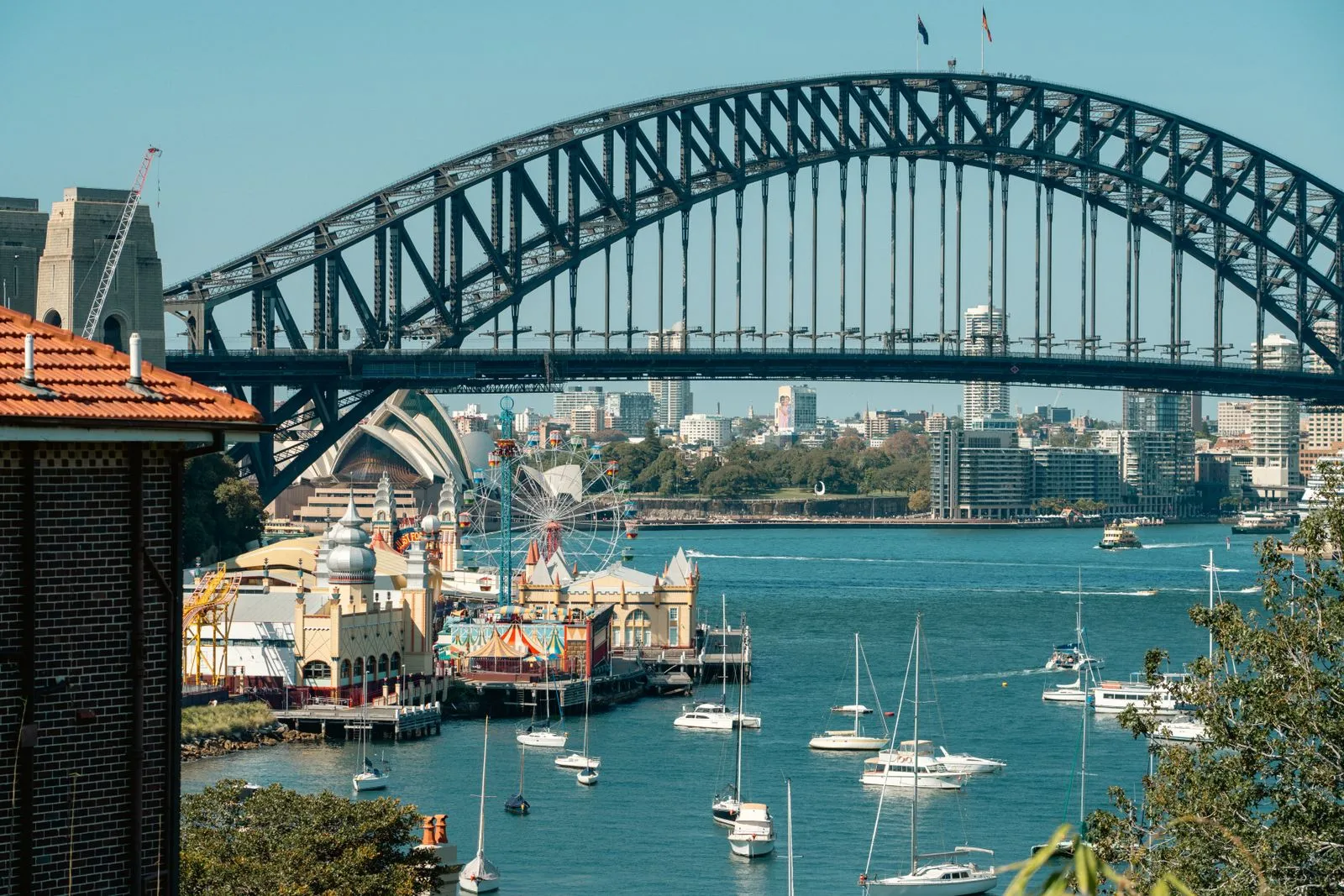
Sydney Harbour Bridge crossing
Between the shores
Closed to traffic on race day, which is why you cannot drive between start and finish.
15:40
Course cut-off
Opera House Forecourt
Seven hours from the start.
Hard cutoff
A harbour between the start and the finish
Sydney reads like a city-centre marathon and behaves like a point-to-point one. The race begins at St Leonards Park on Miller Street in North Sydney, crosses the Harbour Bridge, and finishes on the forecourt of the Opera House. Start and finish are perhaps three kilometres apart as the crow flies, and separated by a body of water with a small number of crossings, all of which are affected on race day.
That geography is the whole problem. It is not a long distance in the way that Boston’s twenty-six miles to Hopkinton is a long distance. It is a constrained distance — one where the obvious route between the two ends of your day is the route the race itself is using.
The gun is early, and the cut-off is earlier than it looks
Mass participation starts at 6:30am, with elite wheelchair athletes away at 6:15am. By the standards of the majors that is a very early start: Berlin goes at 8:45, London from about 9:30, Chicago at 7:35.
The number that governs your accommodation, though, is the start line cut-off at 8:40am. That is the last moment at which you can begin the race at all, and everything else about your morning works backwards from it. The organiser has not yet published start group timings within the mass field — those are shared closer to the event, so at the point most people are booking, you know the window but not your precise slot within it.
The practical reading is that you should plan for the early end of that window rather than the late one, because you will not know which applies to you until long after your accommodation is booked.
Free travel, and why it changes the calculation
Sydney does something genuinely useful here. Travel on all modes of public transport is included for registered participants and volunteers — you simply show your race bib to transport staff when boarding, with no need to tap on or off. Extra early-morning services run specifically to get runners to the start.
This matters more than it sounds. In most marathon cities, staying further out to save money means paying for transport and accepting risk. In Sydney, the money part disappears entirely: a hotel three stops up the North Shore line costs you time, not fare. That makes the outer zones meaningfully more attractive than they would be elsewhere, provided you are relaxed about the morning.
What free travel does not do is remove the dependency. A free train that runs late is exactly as unhelpful as an expensive one.
The bridge is the reason you cannot drive
The Harbour Bridge closes for the race, and major road closures operate around both the start and the finish. The organiser’s guidance is unambiguous that public transport is the best way to and from the event, and for once that is not a sustainability line. There is genuinely no sensible driving route between the northern start and the southern finish while the race is on it.
If you are staying on the north side, this means your return journey after finishing is a train or a long walk, not a taxi to your door. If you are staying in the city, it means your outbound journey is a train under the harbour rather than a car across it. Either way, the water dictates the shape of your day.
Where this leaves the accommodation decision
Sydney splits cleanly along the same axis as Boston and London, but with a much shorter distance involved, which makes both options genuinely viable rather than one being obviously wrong.
North Sydney and Milsons Point put you within walking distance of the start. On a 6:30am gun that is worth a great deal: you get up, you walk, and nothing between you and the start line can fail. The cost is that you finish across the harbour and have to come back, and that supply on the north side is a fraction of the city’s.
The CBD and Circular Quay invert it. You take one train under the harbour in the morning, free, frequent, running early specifically for you, and then walk back to your room from the Opera House at the end. For anyone travelling with family, this is clearly the better base, because the north side has much less to do while you are running.
The North Shore line further out is the price play, and free travel makes it more sensible than the equivalent elsewhere. You are on the line that serves the start, and the fare is zero. What you are buying with the saving is two journeys on the day, the second of which happens after forty-two kilometres.
One thing we could not verify
There is a widely repeated claim that bags must be dropped at the race expo several days before the event, with no bag storage available on race day. We could not find this on any official page, and it materially affects what you can carry and therefore what you need from your accommodation.
Rather than repeat something we cannot source, we have left it out. Check your own participant communications and the organiser directly, and if you are staying further out, plan for the possibility that whatever you want after the race needs to already be at your hotel.
When to book
Sydney joined the Abbott World Marathon Majors recently, and the practical consequence for accommodation is that demand has risen faster than the city’s race-weekend supply has. The ballot and entry routes open late in the preceding year, so accepted runners know roughly nine months out.
North Sydney is the constraint. The CBD has enough hotel stock to absorb a marathon weekend; the northern side does not, and it is the side with the start line on it.
1.17 kilometres of water
The constraint at the top of this page deserves a number, and it is a small one.
We geocoded the Milsons Point start and the Opera House finish and measured them: 1.17 kilometres apart. That is the shortest start-to-finish separation of any race covered here — shorter than Berlin’s 1.78 kilometres, shorter than Cape Town’s precinct.
And it is completely useless to you, because the 1.17 kilometres is water.
There is exactly one pedestrian route between those two points — the Harbour Bridge, and the race is running over it. That is the whole constraint in one line: two places you can nearly see across, with the only link between them closed for the morning. Every other race on this site is solved by walking further; this one cannot be.
Against the two ends, the zones sit like this:
| Zone | To the start (Milsons Point) | To the finish |
|---|---|---|
| North Sydney | 1.44 km | 2.60 km |
| Circular Quay | 1.58 km | 0.62 km |
| Sydney CBD | 2.54 km | 1.54 km |
Note what the numbers do not say. Circular Quay looks close to the start at 1.58 kilometres, and on a map it is, but that measurement crosses the harbour, so the real journey is a train under it. North Sydney’s 1.44 kilometres is on the same side of the water as the start, and is therefore the only one of the three you can actually walk before the bridge closes.
This is the rare case where the straight-line distance is actively misleading, and it is why this guide keeps insisting on the northern side despite the CBD looking closer on paper.
The city has already lost nearly two-thirds of its rooms
Sydney is the nearest race on this site — 26 days from the date of this check, which makes its numbers the most consequential rather than the most predictive.
Checked on 4 August 2026:
| Race weekend 28–31 Aug 2026 | Control 4–7 Sep 2026 | |
|---|---|---|
| Properties on Booking.com | 741 | 1,992 |
Thirty-seven per cent remaining, the tightest of any race we measured except Boston, where the continuous weekend could not be booked at all.
Price, on five major CBD hotels appearing in both searches:
| Property | Race weekend | Control | Multiple |
|---|---|---|---|
| Castlereagh Boutique Hotel | A$2,062 | A$595 | 3.47× |
| Swissotel Sydney | A$2,527 | A$937 | 2.70× |
| QT Sydney | A$2,775 | A$1,187 | 2.34× |
| Sheraton Grand Hyde Park | A$3,197 | A$1,397 | 2.29× |
| Hilton Sydney | A$2,557 | A$1,237 | 2.07× |
Median 2.3 times the ordinary rate, on five established hotels rather than apartment listings, which makes it a solid figure.
If you are running Sydney this year and have not booked, that is the situation you are booking into, and the northern side, the side this page recommends — is the thinner of the two to begin with. The honest advice at 26 days out is to take what is available on the north side over something better on the south, and to treat the bridge closure rather than the room quality as the thing that decides your morning.
Verified race-morning logistics
| What | When |
|---|---|
| Shuttle / bus window | Extra early-morning public transport services |
| Last departure · hard cutoff | 08:40, start line cut-off |
| Corral closes · hard cutoff | Start groups TBA by organiser |
| Road closures | Course cut-off 7 hours, 15:40 |
Start-group timings are not yet published, the organiser states they will be shared closer to event day. Baggage arrangements are not confirmed on any official page and are deliberately omitted here; check your participant communications. Harbour Bridge closure times should be confirmed via Transport for NSW closer to the date.
Verified against the official race source. Always reconfirm in the week before you travel.
Where to stay: the three zones
Distances below are to North Sydney station, the point you actually have to reach, which is not always the start line.
North Sydney / Milsons Point
- To North Sydney station
- 1.4km, walk, and on the same side of the water
- To finish
- Across the harbour
- Price
- $$$
The lowest-risk morning. Best if you are chasing a time and want nothing between you and the start.
What's available in North SydneyWorks because
- Walk to St Leonards Park on a morning that starts before dawn
- No dependency on a train running at 5am
- Quieter than the city side the night before
Costs you
- You finish on the far side of the harbour and have to get back
- Much smaller supply than the CBD, so it sells out first
- Fewer options for family who are not running
Our pick
CBD / Circular Quay
- To North Sydney station
- One train stop under the harbour
- To finish
- Walk to the Opera House
- Price
- $$$$
The best-balanced choice for most runners, and the obvious one if anyone is travelling with you.
What's available in Sydney CBDWorks because
- Walk back from the Opera House finish, which is the leg that matters
- Best position for supporters and for the rest of the weekend
- Deepest supply, and the bib gives you free travel to the start
Costs you
- A train journey before a hard cut-off, in the early morning
- Most expensive area on race weekend
- Heavy closures around the finish
North Shore line: Crows Nest, St Leonards, Chatswood
- To North Sydney station
- Short train ride down the line
- To finish
- Longer return across the harbour
- Price
- $$
Sensible on price if you are relaxed about the morning and not chasing a time.
What's available in ChatswoodWorks because
- Materially cheaper, with availability when the CBD has gone
- Sits on the line that serves the start directly
- Free travel means the extra distance costs nothing but time
Costs you
- Two journeys on the day, and the second one is after 42 kilometres
- Very little around you once the race is over
Zone links open a search for those dates. We earn a commission if you book through one, and it never changes which zone we recommend.
Accommodation near North Sydney station, near the start
Live prices for Sydney Marathon weekend ( –), centred on the point you have to reach, not the start line.
Loading accommodation map…
We earn a commission if you book through this map. It never affects which zones we recommend, and it never changes a verified logistical fact.
Common questions
Where does the Sydney Marathon actually start?
At St Leonards Park on Miller Street in North Sydney — on the northern side of the harbour. The finish is at the Sydney Opera House Forecourt on the southern side, which is why this race is a genuine point-to-point despite feeling like a city loop.
What time does the race start?
Elite wheelchair athletes go at 6:15am and mass participation at 6:30am. Start group timings within the mass field are published closer to the event, so check your participant communications rather than assuming a wave time.
What is the cut-off to start?
8:40am is the start line cut-off. After that you cannot begin the race. The overall course cut-off is seven hours, closing the finish at 3:40pm.
Is public transport free for runners?
Yes. Travel on all modes is included for registered participants and volunteers — you show your race bib to transport staff when boarding, with no need to tap on or off. Extra early-morning services run to the start.
Can I drive to the start?
You should not plan to. Major road closures are in place and the organiser is direct that public transport is the best way to and from the event. The Harbour Bridge itself closes for the race, so driving between the start and finish is not possible.
Should I stay on the north side or in the city?
It depends on whether you fear the morning or the afternoon. North Sydney lets you walk to the start on a 6:30am gun. The CBD lets you walk back from the Opera House at the end. Both are defensible; the CBD is the better bet if anyone is travelling with you.
What about bag drop?
We have not been able to confirm the baggage arrangements on any official page, and there are conflicting accounts circulating. Rather than guess at something that determines what you can carry, check your own participant communications and the organiser directly.
How we verified this
Every timing and closure on this page was checked against the organiser's own published sources on the dates below, by H. Ahmad. Research and data collection are AI-assisted; every logistical fact is verified by a human against the official source before publication. We don't take logistics from other guides — courses and cutoffs change between editions, and second-hand data goes stale silently.
- TCS Sydney Marathon: Marathon event pageRace date 30 August 2026; wheelchair start 6:15am; mass start 6:30am; start line cut-off 8:40am; course cut-off 7 hours (3:40pm); start at Miller St, North Sydney; finish at Opera House Forecourtchecked
- TCS Sydney Marathon: Participant TransportStart venue St Leonards Park, North Sydney; free public transport for registered participants on presentation of race bib, no tap on/off; extra early-morning services; major road closures make public transport the recommended optionchecked
- TCS Sydney Marathon: CourseCourse routing across the Sydney Harbour Bridge to the Opera House finishchecked
- TCS Sydney Marathon: FAQsBib collection requirements and participant querieschecked
- Transport for NSW: Sydney Marathon event travelOfficial NSW transport authority event travel guidance and trip planning, linked by the organiserchecked